
Date of Dispatch 14 July 2026 |
Reference No. 8 AF/HO 26-0714 |
Historical Event Date 14 July 1974 | |
Subject Wingman Loyalty -- General Carl Spaatz & Ira Eaker | |
To Neuman, Ty W Maj Gen USAF AFGSC AFGSC/8th AF | |
From Callaway, William L CIV USAF AFGSC 8 AF/HO | |
General, A historic example of loyal Wingman to the very end.
14 July 1974, General Carl “Tooey” Spaatz, the first Chief of Staff of the United States Air Force passed away: During his long military career, General Spaatz had been one of the early pioneers of military aviation and a strong advocated for a United States Air Force, independent from the United States Army.
Early Career: As a young officer, Carl Spaatz experienced air combat in World War I (recognized with three aerial victories) and in the postwar years served as a military test pilot achieving several aviation records. As a test pilot, Spaatz’s contemporaries included Ira Eaker, Eugene Hoy Barksdale, Ellwood Quesada, and Jimmy Doolittle among others. In 1925, Major Spaatz testified in the court martial of Brigadier General Billy Mitchell. In January 1929, Spaatz was the air commander of a military aircraft named “Question Mark” that set a world record of staying aloft for 150 hours, 40 minutes and 11,000 miles by conducting 27 aerial refuelings through a hand-pumped mechanism from a supporting aircraft, He was recognized with the Distinguished Flying Cross. In the rank of Major, he commanded 7th Bombardment Group from 8 May 1929 to 29 October 1931, whose unit honors are bestowed upon today’s 7th Bomb Wing assigned to Eighth Air Force.
World War II: During World War II as a General Officer and senior air leader and advisor, General Spaatz oversaw the buildup and employment of American airpower in North Africa and Europe as well as later in the war served in the Pacific Theater of Operations. During World War II in the European Theater of Operations, General Spaatz commanded Eighth Air Force and supported his long-time friend and aviation comrade, General Ira Eaker. Eaker was the first Commander VIII Bomber Command assigned to Eighth Air Force in England. Spaatz supported Eaker in implementing the long-held American concept of high-altitude strategic daylight aerial bombardment especially through the Combined Bomber Offensive against Nazi Germany and in forging a very effective partnership with the Royal Air Force Bomber Command.
On 22 February 1944, a reorganization of American strategic airpower occurred for the European Theater when Headquarters Eighth Air Force (activated on 28 January 1942) and under the command of General Spaatz was re-designated as the United States Strategic Air Forces in Europe – with General Spaatz assuming command. On the same date, Headquarters VIII Bomber Command (activated on 1 February 1942) was re-designated as Eighth Air Force under the command of General Jimmy Doolittle. (Today’s Eighth Air Force traces its lineage, honors, and history to VIII Bomber Command).
Rest of the Story: As noted, both Generals Spaatz and Eaker were long-time friends, flying comrades, and collaborators who had served together in many staff and flying assignments prior to and during World War II. After the war, their friendship continued and upon General Spaatz’s retirement from active duty on 30 June 1948, Eaker (who had retired as a Lieutenant General on 1 September 1947) secured for Spaatz a civilian position as the military editor of a national magazine. Spaatz also attended the post-war annual reunion of wartime comrades hosted by Eaker with these social events known as the “Castle Coombe Group” with the reunion recipients growing over time beyond the original eight (see explanation farther below).
In 1974, Carl Spaatz was hospitalized at Walter Reed Medical Center for 25 days with Ira Eaker visiting him every day. On 13 July during a visit, Spaatz told Eaker, “I am counting on you to get me out of here.” General (retired) Carl Spaatz suffered his last heart attack at 0130 hours on the morning of 14 July 1974, passing away at age 83.
Ira Eaker, long-time friend and Wingman to Carl Spaatz, oversaw the burial arrangements at the United States Air Force Academy as well as served as the Executor of the Spaatz estate. The Eaker Family – Ira and his wife Ruth – looked after Mrs. Spaatz until retired Geneal Ira Eaker himself passed away on 6 August 1987 at age 91.
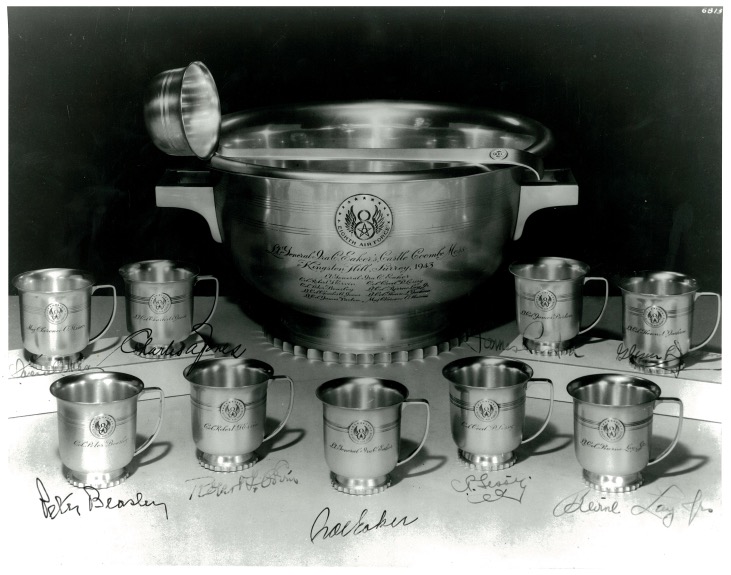
Post-war Reunions: In the post-war years the “Castle Coombe Group” conducted annually reunions – normally held each February – attended by the eight members of General Eaker’s headquarters staff in England who resided together at the Castle Coombe estate in England before General Eaker moved to Italy in early 1944. The sterling silver Castle Coombe Punch Bowl Set (see attached photograph) created in 1944 by the Gorham Company of New York City reflect the upswept wing version of the World War II emblem of Eighth Air Force and with the ranks and names of General Eaker and the eight officers engraved on the punch bowl. Individual cups were engraved also with the Eighth’s emblem and the individual recipient’s name. During these post-war reunions, the Castle Coombe Punch Bowl would be the centerpiece of toasts to what the Eighth Air Force accomplished in the air war over Europe in World War II – and in remembrance of lost comrades. The number of attendees for these reunions grew in size over time and included others associated with the Eighth in World War II, like General Spaatz. However, with the passage of time and with the passing of veteran attendees, the reunions began to get smaller.
Heraldic Device: On 28 April 1981, General Eaker presented the punch bowl, ladle, and his cup to Lieutenant General Edgar S. Harris, Jr, the then Commander (#35) of Eighth Air Force stationed at Barksdale AFB, Louisiana. Subsequently five additional cups were presented to the Eighth Air Force. The Castle Coombe Punch Bowl Set nicknamed as the Eaker Bowl Set, is a genuine heraldic device of today’s Eighth Air Force and is on display just outside the Commander’s Office. This heraldic device is a physical link and reflection of the storied history, heritage, achievements, innovations, sacrifices, comradeship, and Wingman valor of The Mighty Eighth Air Force.
Lane
"History tells you where you are going and why."
"History makes you smart. Heritage makes you proud."
Historian, Eighth Air Force
Historian, Joint-Global Strike Operations Center
Historian, Air Forces Strategic-Air Directorates
Historian, 95th Wing
©2026 W. Lane Callaway