Date of Dispatch 8 June 2026 |
Reference No. 8 AF/HO 26-0608 |
Historical Event Date 6 June 1944 | |
Subject Operation Overlord -- D-Day Landings in Normandy | |
To Neuman, Ty W Maj Gen USAF AFGSC AFGSC/8th AF | |
From Callaway, William L CIV USAF AFGSC 8 AF/HO | |
General, Operation Overlord was a singular and decisive event in the history of World War II - where air combat missions flown by Eighth Air Force prior to as well as on the actual D-Day - were significant in shaping the environment for success at Normandy on D-Day, 6 June 1944.
6 June 1944, Operation Overlord, D-Day landings in Normandy, France: On this date, Eighth Air Force (8 AF) surged its airpower - conducted two air combat missions - to support the return of ground forces of the Western Allies to the Continent of Europe.
8 AF Mission #394 dispatched 1,805 bombers with 8 AF Mission #395 dispatching 782 bombers and 2,561 fighter aircraft (including fighters from Ninth Air Force - 9 AF) with both air missions supporting American airborne and glider troops inland behind the beaches - as well supporting - the amphibious landings of American and Allied ground forces on the beaches of Normandy in German-occupied France.
Both air missions conducted by the Eighth on 6 June, dropped 4,852 tons of munitions on German targets at and near the Normandy landing beaches as well as within Northern France. Fighter aircraft conducted multiple tasks including escort to 8 AF bomber formations, interdiction of enemy ground movements, and air combat patrols over the English Channel and Normandy beaches, For both missions, Eighth Air Force lost four bombers and 25 fighters.
Rest of the Story: The focus of 8 AF on D-Day and the landings at Normandy began in earnest on 6 January 1944 when Lieutenant General Jimmy Doolittle became the Commander of VIII Bomber Command (re-designated officially on 22 February 1944 as Eighth Air Force).
General Doolittle and the Eighth had roughly 90 days to accomplish a directive given by General Henry "Hap" Arnold on 27 December 1943. This roughly 90 day span of time was governed by the D-Day operations plan whereby the Supreme Allied Commander, General Dwight D. Eisenhower was to take control of all air forces by mid-April so to start implementing Operation Overlord. (Actual control was assumed by General Eisenhower at 1200 hours on 14 April 1944.)
Per the December 1943 directive, the Eighth in collaboration with the Fifteenth Air Force (15 AF) and the Royal Air Force (RAF) Bomber Command (conducting night time bombings) were to "destroy the enemy air force wherever you find them, in the air, on the ground, and in the factories"...or the planned invasion at Normandy "would not be possible unless the German Air Force is destroyed."
On 1 January 1944, Headquarters United States Strategic Air Forces in Europe (USSTAF) was created by re-designating the original Headquarters Eighth Air Force to be the new USSAF beginning on 20 January 1944 under the command of General Carl Spaatz. (Thus causing as noted, the 22 February 1944 official re-designation of Headquarters VIII Bomber Command to Eighth Air Force - today's Eighth Air Force.) The creation of the USSTAF had two practical purposes. First to be the synchronizing point to coordinate air operations between both 8 AF (operating out of England) and the 15 AF (operating out of Italy). Secondly, to pose a dilemma for the German Air Force (GAF) - to either split the GAF to meet attacks from two different directions - or - concentrate on one direction letting the other direction go uncontested.
Implementing the "destroy the enemy air force" directive was hampered by adverse weather conditions in early 1944 where Western Europe experienced deteriorating weather conditions in January extending into mid-February. On 19 February 1944, weather forecasters predicted fair and sustained weather conditions for half a week. This weather improvement forecast caused USSTAF to direct the first sizable and synchronized air operations to commence on 20 February 1944.
With synchronized air operations between the 8 AF, 15 AF, and the RAF Bomber Command - collectively called "Big Week" - an all-out, full-court, and aggressive aerial attacks from 20 to 25 February 1944 was conducted while favorable flying weather conditions allowed. For the days of Big Week, the skies over Germany and Austria were consistently filled with Allied airpower day and night. Specifically Eighth Air Force, for the five days (no missions on 23 February due to adverse weather) dispatched 4,226 bomber and 3,839 fighter sorties (including 9 AF fighters). The RAF Bomber Command dispatched 2,342 night time bomber sorties. During these five days, the Eighth lost 158 bombers and 33 fighters with the 15 AF losing 89 bombers. During these five days, three bomber aircrew members of the Eighth would be noted for their valor becoming recipients of the Medal of Honor.
Results of Big Week: During Big Week, it was estimated 70 to 75 percent of the German aircraft manufacturing infrastructure was either destroyed or heavily damaged. The GAF lost 641 aircraft destroyed, 177 probably destroyed, and 264 damaged. Hundreds of GAF personnel and German factory workers became casualties. The dynamic losses by the GAF led to the Western Allies gaining air superiority over Western Europe and the GAF air operations became more of an economy of force and point defense of critical and sensitive targets.
Leading to D-Day: After Big Week the weather again turned adverse and remained so for nearly another month. Allied air operations were executed when the weather permitted with the primary targets for the Eighth some 15 days before the planned D-Day date being German marshalling yards, road and rail bridges, railroad locomotives and rolling stock, railroad infrastructure, revisit of German airfields in France, and a focus on the German long-range rocket launching sites in the Pas-de-Calais coastal area of France. Beginning on 25 May, the Eighth began air attacks along the "Atlantic Wall" - the German-occupied coastal area of France - with a focus on German coastal artillery positions as well as air attacks on the German network of radar stations. These air attacks were executed without compromising the soon-to-happen amphibious assault areas of the Normandy beaches.
Continued adverse weather caused General Eisenhower to postpone the invasion. If the invasion had to be postponed until after 7 June, then Overlord would have to be delayed altogether for another month due to expected changes in tides. At 0415 hours in the early morning of 5 June, the decision was made by General Eisenhower to launch Overlord on 6 June. Receiving this decision, General Doolittle at 2200 hours in the evening of 5 June, directed the bomber aircrews of the Eighth to be prepared to use blind bombing techniques in striking German positions on designated beaches due to the expected cloudy weather.
As D-Day approached and as General Eisenhower visited with ground assault troops, he repeatedly stated: "If you see fighting aircraft over you, they will be ours." The General was correct. On 6 June 1944, D-Day - Western Allied air force few nearly 15,000 air sorties on this single day. The GAF launched 319 sorties with very few reaching the landing beaches of Normandy. Besides bomber aircraft and fighters aircraft striking designated targets on and around the beaches, the totality of American air power included aircraft flying weather missions, conducting propaganda leaflet drops, reconnaissance sorites, maintaining an air cap over the beaches as well as cargo aircraft conducting airdrop of airborne troops and gliders landing behind the beaches with assault troops.
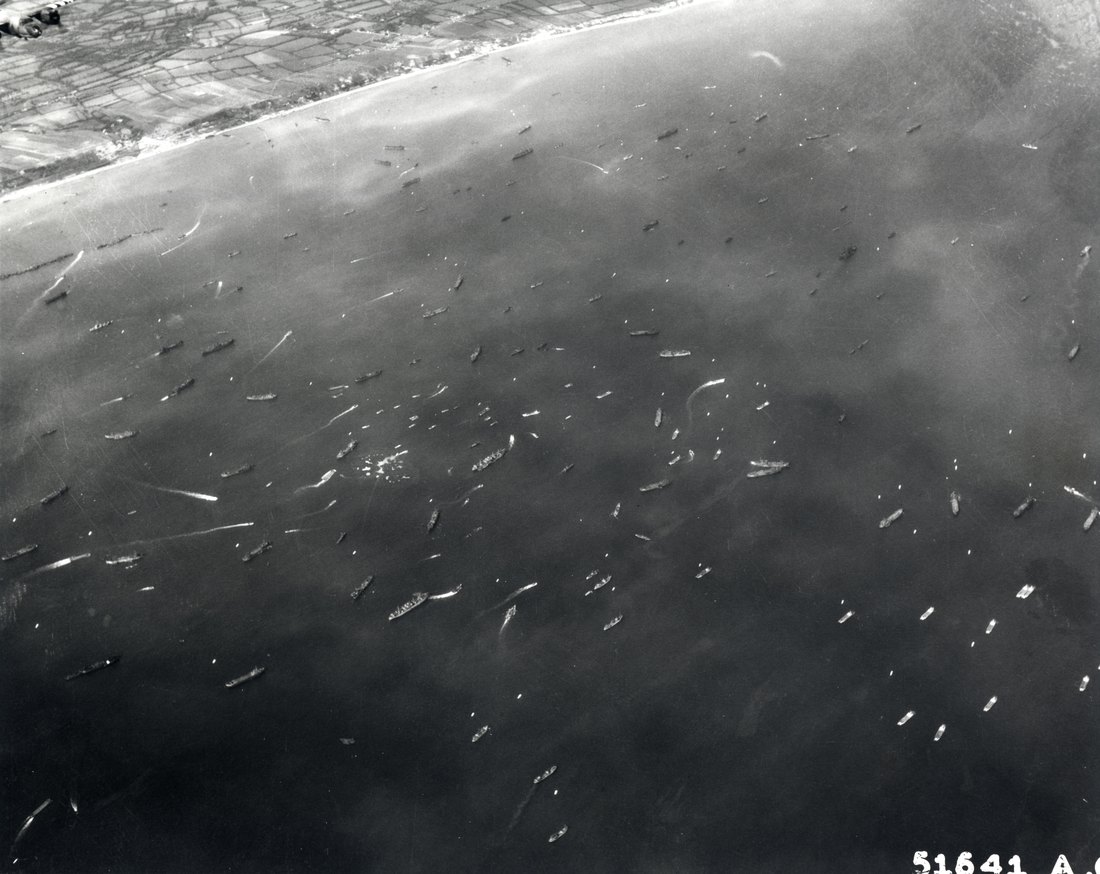
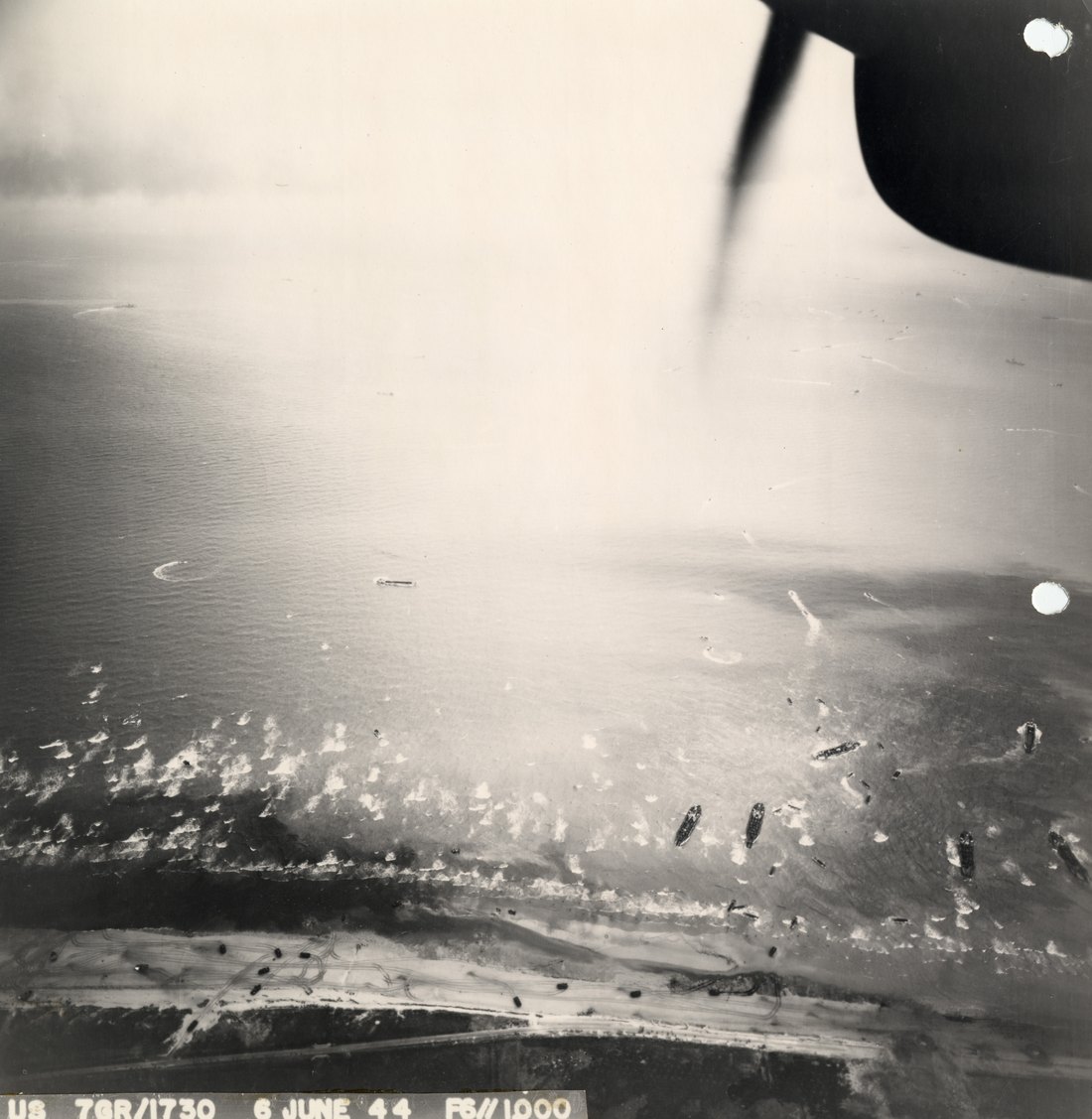
Of the thousands of sorties launched by the Eighth on 6 June, two P-38 fighters had a special mission. The respective pilots of these P-38 fighters flew over the landing beaches for some 150 minutes making observations. Attached are two photographs of what these two pilots probably saw over the landing beaches of Normandy on 6 June 1944. After landing back in England, the senior pilot provided an eyewitness report directly to General Eisenhower of the success of the invasion. The senior pilot reporting directly to General Eisenhower, the Supreme Allied Commander, was General Jimmy Doolittle, the Commander Eighth Air Force.
The Eighth Air Force's senior leadership and staff, unit commanders and their staffs, air and ground crews, support personnel, and civilian contractors assigned to the Eighth all under the command of General Jimmy Doolittle made a positive difference at Normandy by accomplishing the earlier strategic air task contained in the directive given by General Arnold in December 1943.
Historian's Note: On 6 June 2025, Major General Armagost the 57th Commander Eighth Air Force was at Normandy, France and unveiled The Mighty Eighth Air Force Monument memorial as part of the D-Day 81st Anniversary events hosted by The Normandy Institute.
Lane
"History tells you where you are going and why."
"History makes you smart. Heritage makes you proud."
Historian, Eighth Air Force
Historian, Joint-Global Strike Operations Center
Historian, Air Forces Strategic-Air Directorates
Historian, 95th Wing
©2026 W. Lane Callaway