Date of Dispatch 8 May 2026 |
Reference No. 8 AF/HO 26-0508 |
Historical Event Date 8 May 1945 | |
Subject V-E Day -- Formal Surrender of Germany | |
To Neuman, Ty W Maj Gen USAF AFGSC AFGSC/8th AF | |
From Callaway, William L CIV USAF AFGSC 8 AF/HO | |
General, The 81st Anniversary of a significant global history event.
8 May 1945, World War II in Europe ended: Victory in Europe - V-E Day in the United States, VE Day in the United Kingdom, and Victory Day on 9 May in the former Soviet Union - was proclaimed with the military surrender of Nazi Germany at 0241 hours, 7 May at Reims, France followed by a formal ceremony in Berlin on 8 May.
Rest of the Story: Eighth Air Force (8 AF) significantly contributed to the air war over Europe beginning with its inaugural bomber strike on 4 July 1942. The Eighth using bomber, fighter, and special operations aircraft conducted 986 air missions with some 600,000 sorties in the skies over 13 European countries with most air operations over Germany and occupied France.
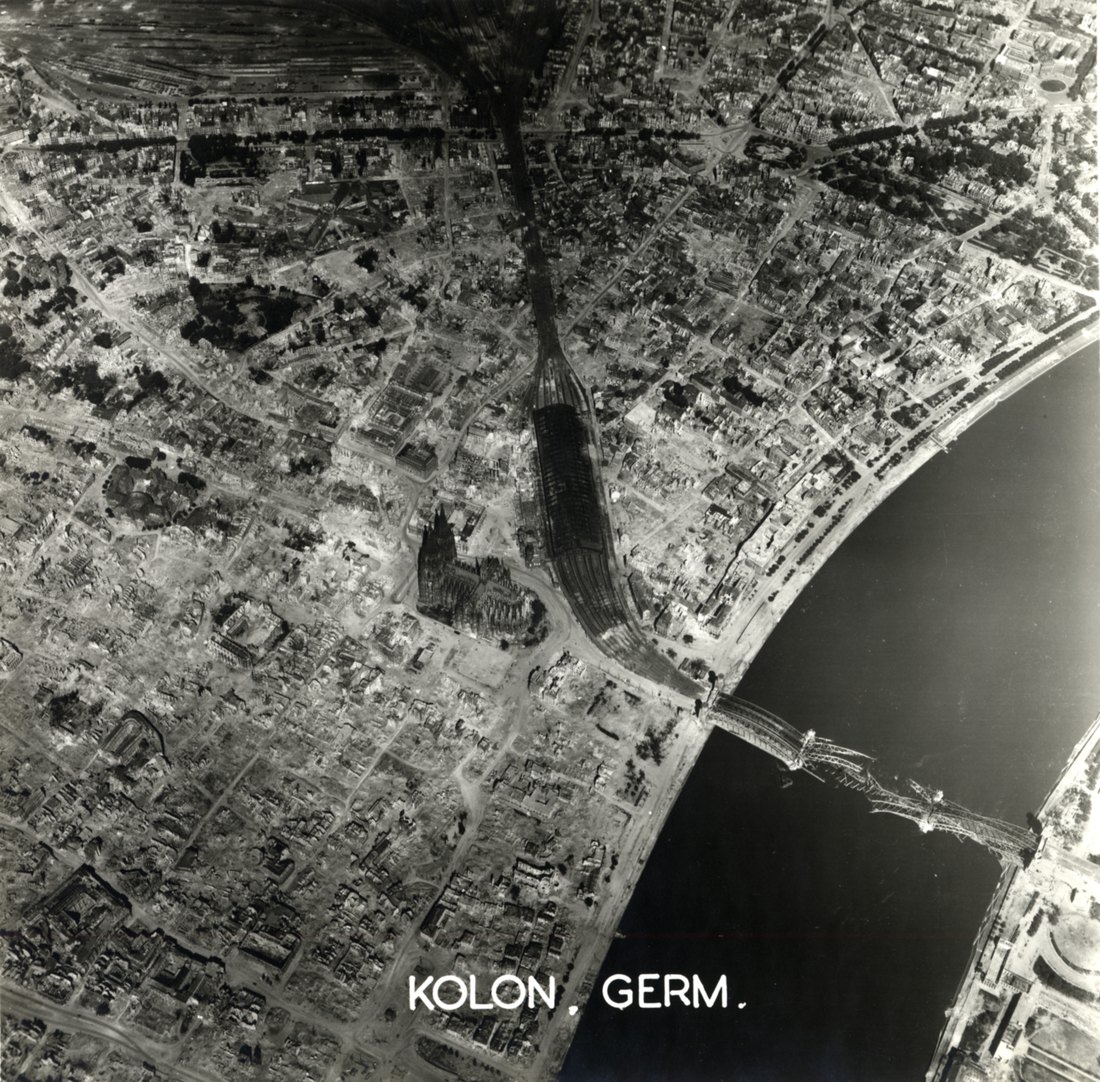
The Eighth's top four strategic targets in order of times struck included transportation, targets in urban areas (primarily military command and control facilities and manufacturing complexes), airfields, and oil facilities. Total bomb tonnage dropped was over 687,000 tons. Of the bombs dropped by 8 AF, it was estimated 76 percent were dropped on the German homeland. (Source: Bombing the European Axis Powers by Richard G. Davis.) Attached is an aerial view of Cologne, Germany on 7 May 1945.
After the formal end of the war, it was accepted by the Eighth's wartime commanders and senior leaders; that 26,000 would be the accepted number of air warriors killed in action while serving with The Mighty Eighth Air Force.
All American Team Heritage: The centerpiece of the Eighth's heroism, contributions, sacrifices, and achievements in the air war over Europe, was human power including aircrews, ground crews, support personnel, civilian contractors, and a team of experienced innovation experts with many from industry and academia. This All American Team either assigned to the Eighth Air Force or in direct support of the Eighth in England, includes Americans from almost every state of the United States. The Team included members of the Women's Army Corps, Black American soldiers assigned to the U.S. Army's 1511st Quartermaster Truck Company (that kept a steady flow of munitions and supplies from the Port of Liverpool to 8 AF airbases in East England), and contractor civilians from both American industry and universities, especially those universities with engineering or technical research programs.
As well human power from unique American communities like Sergeant Jimmy Fong, a Chinese-American - a B-17 mechanic with the Eighth's 398th Bomb Group - and Staff Sergeant Ben Kuroki, a B-24 top turret gunner in the Eighth's 93d Bomb Group who completed 30 air combat missions in Europe and after rotating back to the United States would be transferred later to the Pacific Theater of Operations where he completed 28 air combat missions in a B-29 heavy bomber. Sergeant Kuroki was the only Nisei - second-generation Japanese-American - to fly air combat missions in World War II.
Collaboration Partnership: During the air war over Europe, the Eighth forged a close collaboration with the Royal Air Force (RAF) and the industries in England. Areas of collaboration included airfields and associated facilities; synchronized air combat operations especially with the RAF Bomber Command; airspace and radio frequency management; air-sea rescue; sharing of intelligence and technical knowledge; and transfer of actual technology devices. The Eighth had over 350 operational and technical innovations including many used in actual air combat. Two examples: remotely piloted drones using television transmitters provided by the British Broadcasting Company and initial airborne radars provided by the British. After 26 September 1943, some 48 percent of 8 AF air combat missions used airborne radar-assisted bombing techniques.
The RAF provided training areas for use by the Eighth Air Force. When new flying units deployed from the United States as well as individual replacement flying personnel were assigned to the Eighth - both received in-country orientation and advanced flight training. In his most excellent book, titled Air Power, A Global History - noted military Historian, Jeremy Black in England, stated: "In mid-1944, Allied pilots [including Americans] received up to 400 hours of training, but their German counterparts received only 110" (page 133). This training effort among other factors provided vast advantages for Anglo-American aircrews over German Air Force aircrews. Allied airpower coupled with technology and human power were both decisive contributors to bring about V-E Day. And Eighth Air Force garnered 17 Medals of Honor with all recipients being bomber aircrew members.
Airpower Heritage: The only senior Airman in the United States Army Air Forces to witness all three surrender ceremonies in World War II - German surrender to the Western Allies at Reims, the German surrender to the Soviets in Berlin, and on board the U.S.S. Missouri with the surrender of Imperial Japan - was General Carl Spaatz, who in 1947 became the first Chief of Staff of the United States Air Force.
Reflections on World War II: On 1 May 1975, Lieutenant General James Keck (then Vice Commander-in-Chief of Strategic Air Command) and Major General Edgar S. Harris, Jr. (then Chief of Staff, Strategic Air Command and future Commander Eighth Air Force) hosted retired Generals Ira Eaker and Jimmy Doolittle at Offutt AFB, Nebraska. This informal gathering was conducted as Eaker and Doolittle - both former Commanders of the Eighth Air Force in World War II - were enroute to London for the 30th Anniversary commemoration ceremony of V-E Day. Both Eaker and Doolittle reminisced about lost colleagues, crucial role of strategic bombers, and being grateful for the unswerving support of Allied partners during the air war over Europe in World War II.
Lane
"History tells you where you are going and why."
"History makes you smart. Heritage makes you proud."
Historian, Eighth Air Force
Historian, Joint-Global Strike Operations Center
Historian, Air Forces Strategic-Air Directorates
Historian, 95th Wing
©2026 W. Lane Callaway