
Date of Dispatch 16 April 2026 |
Reference No. 8 AF/HO 26-0416 |
Historical Event Date 18 April 1942 | |
Subject Audacious Bomber Aircrews -- The Doolittle Raid | |
To Neuman, Ty W Maj Gen USAF AFGSC AFGSC/8th AF | |
From Callaway, William L CIV USAF AFGSC 8 AF/HO | |
General, Arguably the inaugural bomber-centric global strike by the United States with its cascading effects and where a young Eighth Air Force contributed and where there are numerous history-heritage connections. Year 2026 is the 84th Anniversary of the Doolittle Raid.
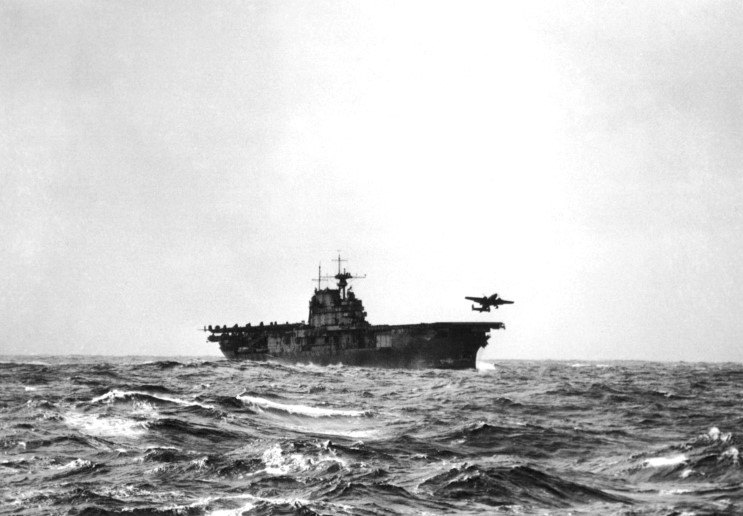
18 April 1942, Doolittle Raiders strike the Home Islands of Imperial Japan: This daring strike by 16 B-25 Mitchell bombers launched from the U.S.S. Hornet aircraft carrier was the first strike by the United States on the Home Islands after Imperial Japan's attack on Pearl Harbor in the Hawaiian Islands on 7 December 1941. Senior military leaders of Imperial Japan underestimated American ingenuity in launching land-based bomber aircraft from a naval vessel while at sea.
Although minor physical damage was done on the targets struck in Tokyo, Yokohama, Kobe, Osaka, and Nagoya - this daring aerial strike on Home Islands stunned the Japanese leadership and triggered cascading strategic effects as well as raised the morale of Americans after the surprise attack on Pearl Harbor. A Japanese radio broadcast on 18 April 1942, reported the American attack on the Home Islands with the official American announcement made on 10 May 1942.
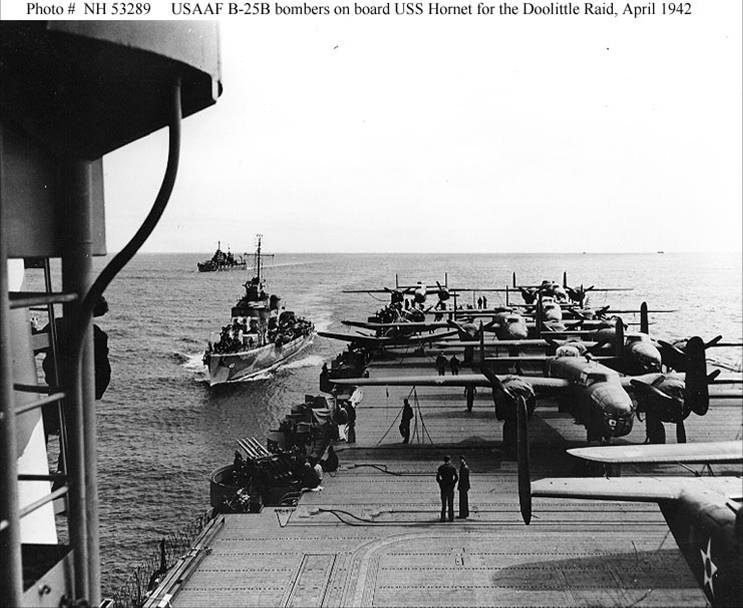
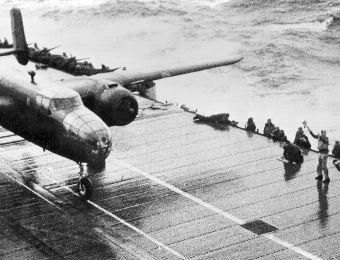
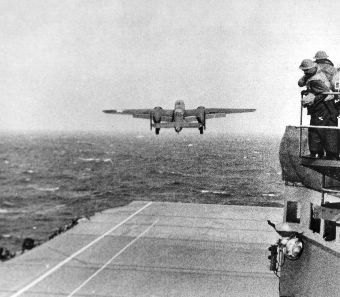
Connection to Eighth Air Force: The B-25s and their aircrews (all volunteers) conducting what became known as the Doolittle Raid came from the 17th Bomb Group (17 BG) assigned to Eighth Air Force. Only 16 of the Group's 20 assigned B-25 bombers could fit on the flight desk of the U.S.S. Hornet (see attached photographs). The flight deck of the Horet was only 809 feet in length, so the initial B-26 - Raider 1 - to launch only had 467 feet to work with in launching. The squadrons of the 17 BG provided their B-25s with their assigned aircrews and came from bomber squadrons - the 95th, 34th, and 37th Bomb Squadrons. (Today's 34th and 37th Bomb Squadrons are assigned to the Eighth's 28th Bomb Wing.) All 20 aircrews assigned to the 17 BG were on the Hornet with the four extra crews for backup but later returned with the Hornet.
Doolittle Raiders: Once launched from the U.S.S. Hornet, all 16 Doolittle Raiders struck their assigned targets on the Home Islands and after bomb drop departed Japanese airspace. Of the aircrews, 13 crash landed or bailed out along the coast of China where they were rescued by the Chinese and eventually returned to American military control. One Raider aircrew landed in neutral Soviet Union but later released (although the Russians kept the aircraft). Two Raider aircrews were captured by the Japanese. Of these 10 aircrew members, two were killed when their respective B-25 crashed landed; three captured Raiders airmen were executed by the Japanese on 15 October 1942, another one died in captivity, and four Raider airmen were liberated in 1945.
Cascading Strategic Effects: Strikes by the Doolittle Raid closed an ongoing and heated debate among the Imperial War Cabinet. This debate centered on whether to consolidate Japanese military gains in the Pacific Ocean area - an economy of force measure - so to shift military power and units to pursue the Imperial Army's land campaign in China. The alternative - expand the Japanese defense perimeter farther into the Pacific Ocean as advocated by Admiral Yamamoto to further push American military power out of the Pacific back to the West Coast of the Continental United States therefore limiting the projection of American military strikes and operations into the Pacific.
The Doolittle Raid closed this debate with the Imperial War Cabinet deciding to expand the defense perimeter farther into the Pacific by seizing or neutralizing the Hawaiian Islands and its use by American military forces. To implement this strategic decision against Hawaii, Japanese military forces had to seize the tiny island of Midway and use it as an advance base for striking Hawaii. This intended seizure of Midway Island set the stage for an epic air and sea battle resulting in a decisive American victory. During the Battle of Midway in June 1942, the Imperial Navy lost four aircraft carriers and nearly 30 percent of its experienced carrier pilots and nearly 40 percent of its experienced flight deck crews (aircraft mechanics, technicians, flight deck controllers, and armorers). The totality of these losses reduced Imperial Japan's ability to project military power into the Pacific Ocean.
Raiders Connection to Barksdale Field: Of the 80 Raiders who participated in the Doolittle Raid, 14 officers and four enlisted had trained at Barksdale Field either as a pilot, bombardier, gunner, or other training programs during the 1939 to 1941 timeframe. On 20 June 1942, the 17th Bomb Group was reconstituted and assigned to Barksdale Field for unit training. Brigadier General Doolittle (skipping the rank of Colonel) visited Barksdale Field and the reconstituted 17 BG on 11 July 1942.
Enlisted Aircrew Member Heritage: One of the enlisted Raiders, Technical Sergeant Waldo J. Bither (enlisted bombardier on Raider 12) was originally from Maine but when stationed at Barksdale Field, his son was born in Shreveport. On 2 September 1942, the Shreveport and Bossier City communities observed "Tokyo Raider Day" where the Distinguished Flying Cross was presented to Sergeant Bither for his participation in the Doolittle Raid on 18 April 1942.
Eighth Air Force Heritage: On 1 February 2017, marking the 75th Anniversary of Eighth Air Force, the Commander (#53) Eighth Air Force, then Major General Thomas A. Bussiere dedicated the Eighth's headquarters building on Barksdale AFB as the "General James H. (Jimmy) Doolittle Hall." This memorialization honors General Doolittle who commanded Eighth Air Force a number of times and on 18 April 1942 led audacious and brave aircrews who launched land-base bomber aircraft from the deck of an American aircraft carrier at sea to conduct the inaugural American air strike into the very heartland of a then enemy nation.
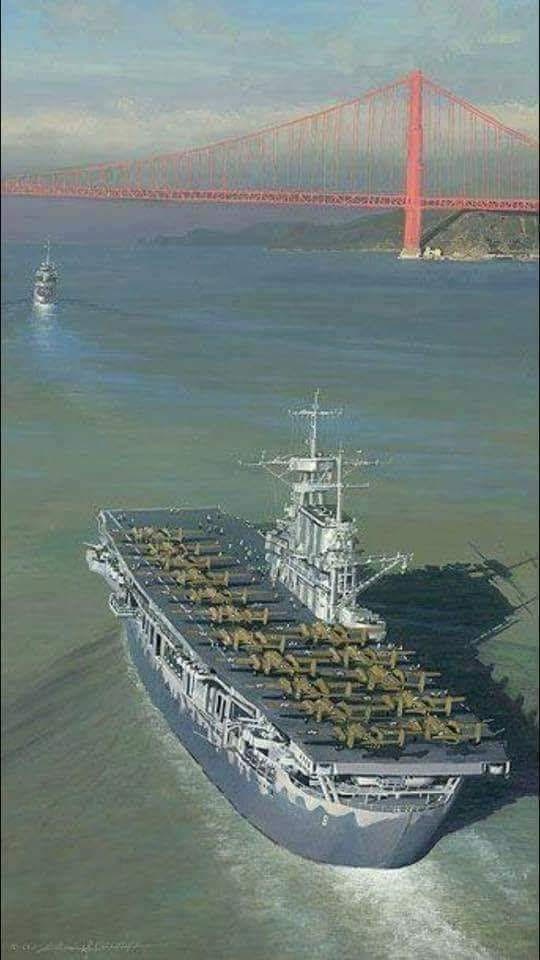
Technical and Operational Innovations: For the 82d Anniversary of the Doolittle Raid in April 2024 the 8 AF's Humble Historian provided a talk on the Doolittle Raiders at the Bossier History Center. This talk provided the historical and heritage significance of the Raid as well as generally unknown "thinking out of the box" innovations. The numerous innovations were applied through a collective effort between the Raiders, United States Navy, United States Army Air Forces, and American industry in melding two different technologies - launching land-based bombers off an aircraft carrier at sea to successfully complete the assigned mission. The time span from start of planning the mission to sailing out of San Franciso Bay shown in the first attached photograph was 99 days.
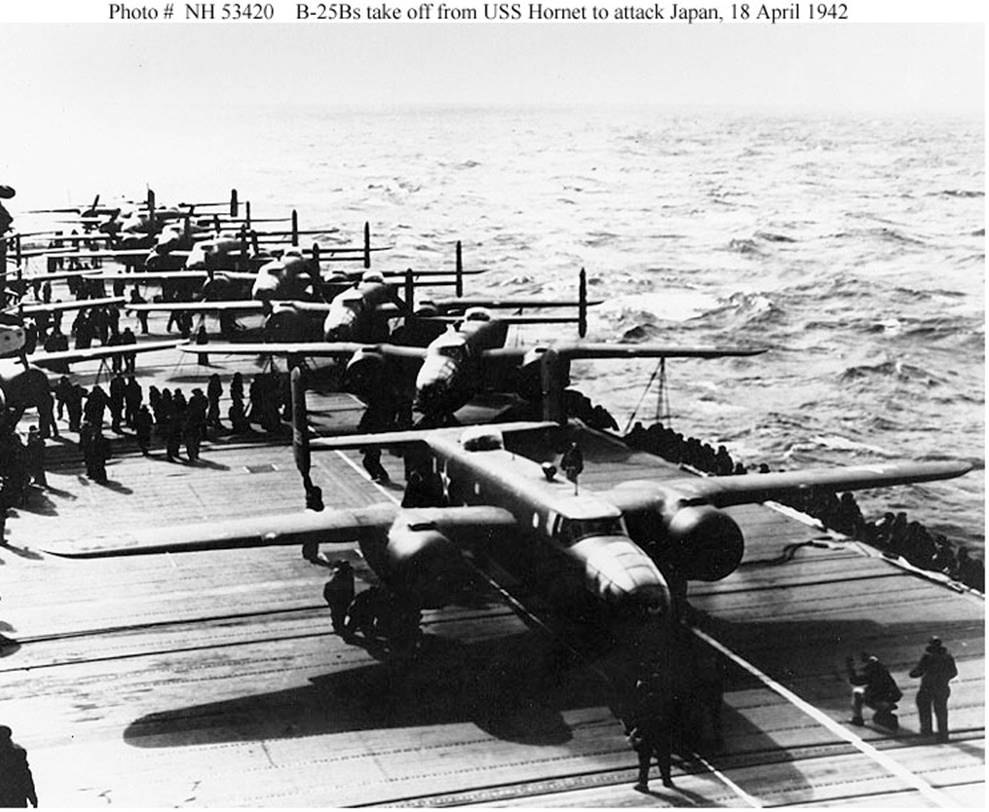
One collaborative innovation example can be seen in photographs #3 and #4 where white lines were painted on the flight deck of the U.S.S. Hornet. These white lines provided visual guides for the B-25 pilots when launching from the carrier. These simple white lines aided in aligning the bomber's nose and left-side wheels so to keep the bomber's right wing tip six feet away from the carrier's "island" or Conning Tower.
Lane
"History tells you where you are going and why."
"History makes you smart. Heritage makes you proud."
Historian, Eighth Air Force
Historian, Joint-Global Strike Operations Center
Historian, Air Forces Strategic-Air Directorates
Historian, 95th Wing
©2026 W. Lane Callaway