

Date of Dispatch 6 April 2026 |
Reference No. 8 AF/HO 26-0406 |
Historical Event Date 5 April 1943 | |
Subject Bomber Aircrew and Enlisted Heroism -- TSgt Roskovich | |
To Neuman, Ty W Maj Gen USAF AFGSC AFGSC/8th AF | |
From Callaway, William L CIV USAF AFGSC 8 AF/HO | |
General, Two "firsts' with one leading to a tough decision made by an Eighth Air Force Commander.
5 April 1943, Air strike on an industrial area of German-occupied Antwerp, Belgium: VIII BC Mission #50 dispatched a mixed force of B-17 and B-24 bombers to strike the Erla Aero Engine Company factory in Antwerp. Moderate damage was done to the designated target with four bombers lost and another 13 sustained battle damage. This specific air combat mission contained two "firsts" for Eighth Air Force (8 AF).
The initial "first" was a formal protest from the Belgium Ambassador to the United States for inaccurate bombing by American bombers that allegedly killed civilians in Antwerp. It is not known if the Ambassador was carrying out German propaganda as part of a misinformation campaign or indeed bombs had inadvertently hit a civilian area of Antwerp.
The other "first" was the completion of 25 air combat missions by a member assigned to Eighth Air Force. Per the personnel policies at the time, upon completing the required 25 air combat missions, the officer or enlisted crew member rotated back to the United States for reassignment. The honor of being the first aircrew member in the Eighth to complete the required 25 missions went to Technical Sergeant (TSgt) Michael "Rosky" Roskovich (see first attached photograph).
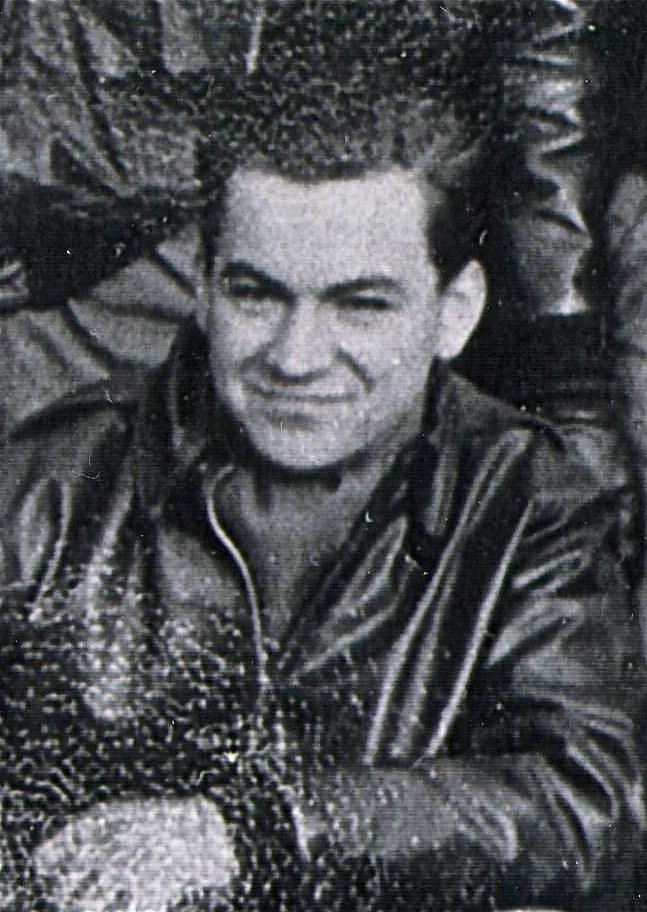
Rest of the Story: TSgt Roskovich from Fayette City, Pennsylvania was a B-17 Flying Fortress radio operator with the Eighth's 306th Bomb Group (306 BG). Due to his Russian ancestry, Roskovich's go-by name in the unit became "The Mad Russian." Upon returning from the 5 April mission to the 306 BG's home station at Thurleigh, England - TSgt Roskovich's fellow crew member on the B-17 helped him celebrate accomplishing the 25 mission achievement - but in a unique manner.
Upon exiting the just landed B-17, Rosky was stripped down to only his skivvies and boots with "25 Missions" painted on his back. Getting into the spirit of the celebration, Rosky, borrowed a nearby bicycle ridden out to the landed B-17 by a ground crew member. Rosky rode the bicycle around Thurleigh airfield wearing only his skivvies, boots, and a smile - knowing he had made history and achieved a goal that many a bomber aircrew member in 8 AF had strived to do.
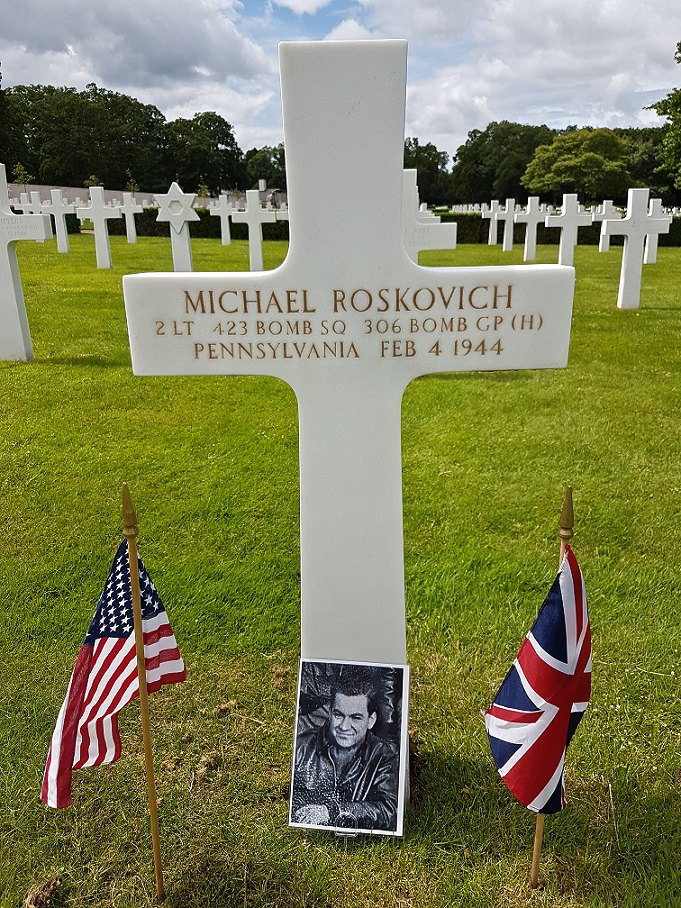
TSgt Roskovich volunteered to extend in the 306 BG in lieu of rotating back to the United States. Subsequently he took a battlefield commission to Second Lieutenant becoming a gunnery instructor. Overtime, Rosky became dissatisfied being an instructor and volunteered to join another B-17 aircrew within the 306 BG where he flew another eight air combat missions. However, on 4 February 1944, Lieutenant Roskovich met his fate when the B-17G (s/n 42-31715) he was aboard for a cross-England training flight, crashed while taking off. Lieutenant "Rosky" Roskovich was killed in the aircraft crash and laid to rest at the Cambridge American Cemetery in England (see second attached photograph).
Tours of Duty for 8 AF Bomber Airmen: In early 1943, General Ira Eaker, the Eighth's Commander, spoke with General Spaatz about lengthening the tour of all flying personnel from 25 to 30 missions. With mounting losses of bomber aircrews by the Eighth in early 1943, Eaker foresaw a forthcoming personnel challenge. When General Jimmy Doolittle assumed command of 8 AF in February 1944, he changed the tour of duty for bomber aircrews to 30 (originally Doolittle wanted to expand it to 35 missions).
This increase to 30 air combat missions by Eighth Air Force prompted an accompanying change in the personnel policy of the United States Army Air Forces. Bomber flying personnel completing 30 missions would receive 30 days of rest and recuperation in the United States and afterwards these experienced bomber aircrew personnel would be reassigned to a new tour of flying duty. When this policy change was put into practice, most of these experienced bomber aircrew personnel were returned to the European Theater of Operations although some were assigned to the Pacific Theater of Operations.
Rationale for Increase to 30 Missions: General Doolittle's reasoning for the increase was a realization that the Amry Air Forces had received its quota of authorized manpower billets. As well, by 1944 the majority of the personnel moving to Europe within the personnel pipeline were more individual replacements, not like previously were organized units deployed with their assigned personnel to the European Theater of Operations. (Historian's Note: the last B-17 unit, the 398th Bomb Group was assigned to 8 AF in April 1944 and the Eighth's last B-24 unit, the 493d Bomb Group, became operational on 6 June 1944.) General Doolittle correctly anticipated bomber aircrews flying double missions on a daily basis especially as the date approached for the Allied invasion of Western Europe at Normandy and there was a significant increase in the Eighth's operational tempo within German airspace. (Example: the forementioned 398th Bomb Group flew 195 air combat missions starting on 6 May 1944 to 25 April 1945, with 75 percent of these missions conducted in German airspace.)
For many of the bomber aircrew members - both officers and enlisted - who completed their required number of air combat missions but volunteered to extend met the same fate as Michael "Rosky" "The Mad Russian" Roskovich. All were examples of Service before Self.
Historian's Note: The spelling of Michael Roskovich's name comes from his memorial at Cambridge American Cemetery. Interesting his last name appears as "Roscovitch" in Roger Freeman's book The Mighty Eighth War Diary and as "Roscovich" in Don Miller's Masters of the Air book.
Lane
"History tells you where you are going and why."
"History makes you smart. Heritage makes you proud."
Historian, Eighth Air Force
Historian, Joint-Global Strike Operations Center
Historian, Air Forces Strategic-Air Directorates
Historian, 95th Wing
©2026 W. Lane Callaway