Date of Dispatch 24 March 2026 |
Reference No. 8 AF/HO 26-0324 |
Historical Event Date 24 March 1999 | |
Subject Global Strikes -- March 1999 and 2011 | |
To Neuman, Ty W Maj Gen USAF AFGSC AFGSC/8th AF | |
From Callaway, William L CIV USAF AFGSC 8 AF/HO | |
General, Several examples of long-range global strikes by America's bomber fleet conducted in the month of March but in different years.
24 March 1999, Start of Operation Allied Force: This air campaign conducted against then Yugoslavia had a humanitarian goal to save ethnic Albanians living in the Serb province of Kosovo from forced eviction and genocide. Operation Allied Force was conducted by the North Atlantic Treaty Organization (NATO) with NATO military operations lasting until 10 June 1999. In supporting NATO, the United States provided military forces. Specifically the United States Air Force conduced air combat missions, employed the RQ-1 Predator (an unarmed aerial reconnaissance drone) over Serbia, as well as mobilized six Air Force Reserve aerial tanker refueling units and one rescue wing in support of Operation Allied Force.
Rest of the Story: For Operation Allied Force, American participation was conducted under the name of Operation Noble Anvil and implemented in two phases. Phase I was conducted on 24 March with air strikes by B-2A Spirit bomber aircraft from Eighth Air Force's 509th Bomb Wing (509 BW) with this mission being the air combat debut for the B-2A. The designated targets for these Spirit bomber included air defense facilities as well as military command and control nodes. Phase II of Operation Nobel Anvil was conducted on 28 March with B-1B Lancer bomber aircraft from the Eighth's 28th Bomb Wing (28 BW) striking industrial sites and Kosovo-based military forces.
20 and 27-28 March 2011, Operation Odyssey Dawn: The United Stats contributed air and sea forces to a multi-national military effort to enforce a no-fly zone protecting civilians in Libya and to support United Nations Resolution 1973 (adopted on 17 March 2011) providing the legal basis for military intervention for the no-fly zone over Libya. The American-conducted portion was called Operation Odyssey Dawn and was part of a larger coordinated air-sea strike campaign by Allied nations including the United Kingdom (under Operation Ellamy) and France (under Operation Harmattan). Other NATO and non-NATO partners supported the larger effort with a variety of military forces.
Rest of the Story: In late February 2011, Eighth Air Force's 608th Air Operations Center started to create contingency plans for bomber strikes anticipating the approval and implementation of a no-fly zone. This coordinated planning effort was successfully implemented.
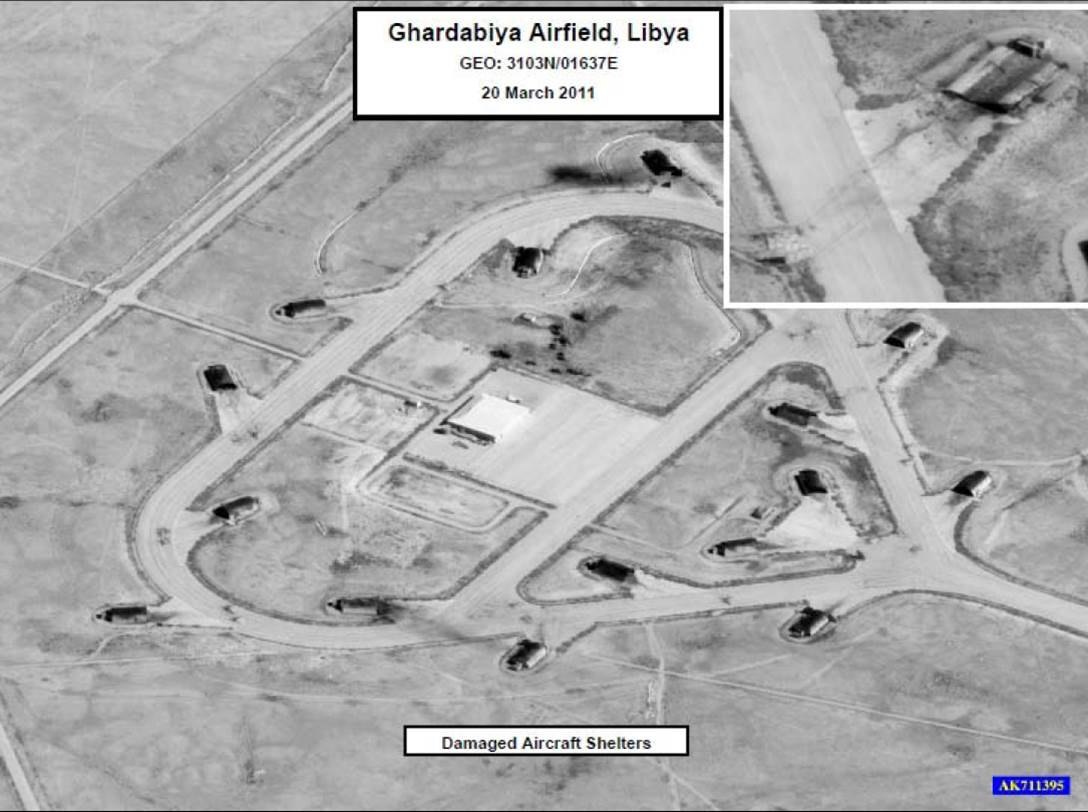
20 March: From Whiteman AFB, Missouri the 509 BW launched three B-2A Spirit bombers to conduct opening air strikes on Libya. During this 33-hour round-trip air combat mission, these bombers delivered 45 Direct Attack Munitions on 10 Libyan air basses (see attached photograph of battle damage on one Libyan airfield). Precision strikes on multiple aircraft shelters at these Libyan air bases constituted the opening phase of Operation Odyssey Dawn.
27 March: From Ellsworth AFB, South Dakota; the 28 BW (at this time assigned to Twelfth Air Force) with only a two-day notice, prepared and launched two B-1B Lancer bomber aircraft to strike 48 targets in Libya during their 21-hour flight. Both B-1Bs landed in a partner country to rearm and refuel in preparation for their return trip to home station.
28 March: After rearming and refueling, these two B-1Bs started on their return 21-hour flight to South Dakota and again struck Libya by hitting 45 targets.
The B-1B strikes conducted on 27 and 28 March were the deepest penetration by American bombers into Libyan airspace. For both days and due to the dynamic and changing situation inside Libya, the aircrews of both B-1Bs received numerous changes in assigned targets while enroute to Libya.
Lane
"History tells you where you are going and why."
"History makes you smart. Heritage makes you proud."
Historian, Eighth Air Force
Historian, Joint-Global Strike Operations Center
Historian, Air Forces Strategic-Air Directorates
Historian, 95th Wing
©2026 W. Lane Callaway