

Date of Dispatch 4 March 2026 |
Reference No. 8 AF/HO 26-0304 |
Historical Event Date 4 March 1944 | |
Subject First Strikes on Berlin -- 8 AF Aircrew Determination | |
To Neuman, Ty W Maj Gen USAF AFGSC AFGSC/8th AF | |
From Callaway, William L CIV USAF AFGSC 8 AF/HO | |
General, Back-to-back air combat missions by Eighth Air Force against a critical strategic target - Berlin. Also a post-war observation of Eighth Air Force by a former high-ranking German Air Force official. And a rather unique personal story of an enlisted air warrior assigned to the Eighth, who saw air combat over Berlin on 6 March 1944.
4 March 1944, First aerial strike by Eighth Air Force (8 AF) on Berlin: 8 AF Mission #247 dispatched 502 B-17 bomber aircraft with VIII FC FO #260 dispatching 770 fighters to strike industrial targets in Berlin, Cologna, Bonn, and Frankfurt.
Due to adverse weather beginning in England and extending into France and Western Germany, three bomber groups turned back at the French coast due to their inability to form into a cohesive strike formation with remaining bomber and fighter formations were recalled upon their reaching the Ruhr Valley of Germany due to the adverse weather. Notwithstanding this recall, 30 B-17 bombers and a handful of fighters did not receive the "raid abandoned" recall and pressed on to their designated target - Berlin.
Coming out of the dense cloud cover over Berlin, this small striking force composed of bomber and fighters from different units within the Eighth assembled around the 95th Bomb Group with the formation leader being Colonel Harry C. Mumford. And it dawn on these aircrews over Berlin that their small formation was by its lonesome. Under these circumstances, these brave 8 AF aircrews did what they could only do - find the target and strike it. (Historian's Note: Today's 95th Wing assigned to Eighth Air Force, traces its lineage and heritage to the 95th Bomb Group of World War II fame.)
For this first-ever 8 AF strike on Berlin, five bombers were lost. The German Air Force (GAF) was greatly embarrassed with the capital city of Nazi Germany struck by American airpower. Upon returning home to England, Colonel Mumford received the Silver Star for leading this ad hoc formation in carrying out this inaugural strike by the Eighth on Berlin. Just as significantly, the ethos of "tenacity" of 8 AF aircrews carrying out their assigned mission (unless receiving a recall) was reinforced and became one of the two observations about The Mighty Eighth made by GAF pilots in post-war interviews. (The other GAF observation was "loyalty to wingman" among 8 AF aircrews.)
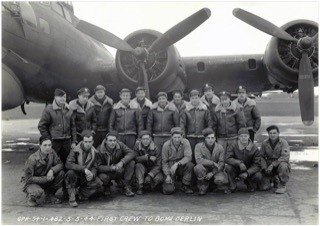
Historian's Note: The actual first 8 AF bomber aircraft credited with dropping bombs on Berlin was a Pathfinder B-17 from the 482d Bomb Group. Attached is a post-strike photograph of the air and ground crews of this history-making bomber, provided courtesy of Mr. John J. O'Neil III whose late father - Staff Sergeant John J. O'Neil, Jr. - was a gunner on this history making B-17. John O'Neil served many years on the Board of Trustees for The National Museum of the Mighty Eighth Air Force located near Savannah, Georgia,
6 March 1944, First-large scale attack by 8 AF on Berlin: 8 AF Mission #250 dispatched 730 bombers - a mix of B-17s and B-24s - with VIII FC FO #262 dispatching 810 fighters to strike industrial sites in Northern Germany with the primary targets in the suburbs of Berlin. This massive force of bombers dropped 1,648 tons of High Explosive (HE) and incendiary munitions and released 2,448,000 propaganda leaflets over Berlin. In this specific mission, 8 AF lost 69 bombers and 11 fighters.
8 March 1944, continued strikes on Berlin: 8 AF Mission #252 dispatched 623 bombers - a mixed force of B-17s and B-24s - with VIII FC FO #263 dispatching 891 fighters to strike industrial areas including sites in the southern suburbs of Berlin with a major target being the VKF bearing factory that sustained heavy damage. Bombers dropped 1,059.5 tons of HE and incendiary munitions but with a lost by the Eighth of 37 bombers and 18 fighters.
9 March 1944, continued strikes on Berlin: 8 AF Mission #253 dispatched 526 bombers - a mixed force of B-17s and B-24s - with VIII FC FO#264 dispatching 808 fighters with B-17s striking Berlin while B-24 formations struck Hanover, Germany. Bombers dropped a total of 1,207 tons of HE and incendiary munitions plus 2,012,000 leaflets. Eight bombers were lost with a single fighter aircraft downed.
Rest of the Story: Taken together these four air strikes by the Eighth in rapid succession continued to provide evidence that the Western Allies had gained air superiority over Europe, a fact that 8 AF had contributed to with its mid-February 1944 continuous week-long strikes during "Big Week" air offensive against the GAF and its supporting infrastructure. Specifically the 8 March day time bombing of Berlin demonstrated solidarity with a night-time strike on Berlin by the Royal Air Force conducted on the same date. These synchronized, twin companion strikes on 8 March against Berlin countered Nazi propaganda about a split between the Americans and British over conducting strategic air bombardment.
Striking Berlin caused further stress and strain on the GAF's counter-air assets. It was estimated 70 percent of the GAF's fighter strength was in the vicinity of Berlin providing point defense of this critical asset. Berlin was not just the political capital of Nazi Germany, but by this time in the war, Berlin was the largest commercial and industrial city on the European Continent. From a political-military, Chancellor Adolf Hitler had boasted that Berlin would not be bombed during daylight.
A post-war Army Air Forces report written in August 1945, noted that the GAF counter-air effort over Berlin on 6 March, was heavier than normal with anti-aircraft ground (flak) artillery being very intense and accurate augmenting the GAF counter-air fighters. This report contained" "Rocket and air-to-air bombing were attempted and a new type of projectile which burst with a spiraling effect and invariable set fire to aircraft it hit." It was thought this new German projectile was a fused 20mm incendiary munition. This August 1945 report estimated that some 615 fighters had opposed 8 AF over Berlin on 6 March.
GAF counter-air defenses - both fighter and ground based (flak) artillery - were intense in defending Berlin. It is estimated that air attacks conducted in early March 1944 cost the Germans some 334 irreplaceable fighter aircraft and many experienced pilots. This estimate is near the number contained in Roger Freeman's "The Mighty Eighth War Diary" where total claims by Eighth Air Force bomber and fighter aircrews against German aircraft during the four missions over Berlin in early March totaled 345. During the entire month of March 1944 and throughout the entire European Theater, the GAF lost nearly 20 percent of its fighter pilots.
In a post-war interview before his suicide, Reichsmarschall Hermann Goring - the former Supreme Commander of the GAF - answered a question when did he realized Germany had lost the war. In his usual jocular tone and using a vernacular phase of the day about the game being over, he replied: "The first time I saw your [American] bombers came over Hanover, escorted by fighters [P-51 Mustangs], I began to worry. When they [bombers] came with fighter escorts over Berlin - I knew the jig was up." The former Reichsmarschall was correct.
Unique 8 AF Enlisted Heritage: One of the B-24 gunners of the 458th Bomb Group - Sergeant DeSales A. Glover - who was on the 6 March 1944 strike against Berlin, was immediately grounded upon returning to home station in England. It was discovered that this air veteran of six air combat mission and recipient of the Air Medal, was only 16 years of age. When he enlisted in October 1942 by falsifying his age, he was then only 14. Sergeant Glover was sent back to the United States with an Honorable Discharge. Subsequently upon achieving the proper age, he reenlisted and served in the United States Air Force and saw air combat duty in both the Korean and Vietnam wars and retired as a Master Sergeant. He passed away on 24 January 1998 and is interred at the Barrancas National Cemetery in Florida.
Lane
"History tells you where you are going and why."
"History makes you smart. Heritage makes you proud."
Historian, Eighth Air Force
Historian, Joint-Global Strike Operations Center
Historian, Air Forces Strategic-Air Directorates
Historian, 95th Wing
©2026 W. Lane Callaway