
Date of Dispatch 23 February 2026 |
Reference No. 8 AF/HO 26-0223 |
Historical Event Date 20-25 February 1944 | |
Subject "Big Week" -- Decisive Strategic Air Campaign | |
To Neuman, Ty W Maj Gen USAF AFGSC AFGSC/8th AF | |
From Callaway, William L CIV USAF AFGSC 8 AF/HO | |
General, A significant and decisive use of strategic air power influencing the outcome of the air war in Europe during World War II with an example of bomber aircrew heroism.
20-25 February 1944, "Big Week" air campaign: The singular objective of this massive full-court press by Eighth Air Force during what has been called "Big Week" in the history of The Mighty Eighth, was the destruction of the German Air Force.
Strategic Air Campaign: This focused six day combined strategic air campaign was conducted in daylight hours by Eighth Air Force (8 AF) and Ninth Air Force with both operating out of England and with the Fifteenth Air Force (15 AF) operating out of Italy - while the Royal Air Force (RAF) Bomber Command conducting strikes out of England during hours of darkness. The German Air Force (GAF) and its flying units were not the only focal point of this combined strategic air campaign. This Allied air campaign also targeted GAF airfields and air operation facilities as well as German's aircraft and air component manufacturing infrastructure and factories. Big Week significantly resulted in Western Allied air forces gaining air superiority over Western Europe thus achieving a critical prerequisite for the forthcoming Operation Overlord - D-Day at Normandy and the return of Western Allied ground forces to Western Europe.
Rest of the Story: In November 1943, American air planners conceived Operation Argument, an all-out air attack on the German industrial base supporting the GAF. In his guidance dated 27 December 1943, General "Hap" Arnold as the Commanding General of the United States Army Air Forces directed the Commanders of both 8 AF and 15 AF to employ their strategic airpower to: "Destroy the Enemy Air Force wherever you find them, in the air, on the ground, and in the factories. "
The success of this all-out, full-court air campaign hinged upon a sustained period of suitable weather for large flying operations that finally materialized on 19 February 1944. During the next six days, both American and British air forces collaborated their efforts and surged their air capabilities on the GAF and its supporting industrial infrastructure. For Big Week, the Eighth launched 3,922 bomber and 3,839 fighter sorties while the RAF Bomber Command dispatching 2,342 bomber sorites. During Big Week, the skies over Germany, Austria, and Poland were constantly filled with Allied airpower day and night. For the participating bomber aircraft, the Eighth lost 158 while the 15 AF lost 89.
Results of Big Week: It was estimated that 70 to 75 percent of the German aircraft manufacturing infrastructure - both assembly and component factories - were either destroyed or heavily damaged. This destruction led to disruption and delays in the supply chain supporting the GAF as well as available replacement fighter aircraft. The effective use of strategic airpower during Big Week caused the Germans to further accelerate the dispersal of their war-making infrastructure and industrial base - with this effort starting back in August 1943 due to the Eighth's airstrikes on aircraft manufacturing plants and facilities. Now due to the damage done during Big Week, the Germans accelerated the dispersal that in and of itself cause costs to rise, cost time, caused a diversion of effort, and caused stress to find construction materials to build new and smaller factory facilities.
And this new phase of industrial dispersion by the Germans caused a ripple effect - more reliance on German railroad rolling stock, nodes, and facilities to re-direct raw materials to newly constructed dispersed factories and then move finished projects out. (Historian's Note: This dispersion of factories had positive effects with these newly constructed factories having a smaller footprint and being more efficient in manufacturing products.)
Simultaneously this manufacturing dispersal efforts impacted German labor causing in many cases, workers moving to new factory sites away from their homes and families. Beyond the physical destruction of factories, Big Week also caused hundreds of skilled German labor to become casualties. It was discovered, that many air raid shelters built near factories were inadequate and actually contributed to the casualty rate among factory workers.
Big Week Impact on the German Air Force: Big Week caused a crippling attrition of irreplaceable German pilots as wall as aircraft. German records obtained after the war noted a loss of 388 fighter aircraft out of nearly 1,500 available in Western Europe. Many of the GAF fighter aircraft not totally destroyed during Big Week were heavily damaged. It was estimate the GAF lost 433 fighter pilots killed, 227 wounded, and 432 missing - with GAF ground crews personnel included in this missing number. Big Week caused a shift in the GAF's counter-air efforts and tactics from a full-scaled defense-in-depth to an "economy of force" - a conservation of available strength - emphasizing point defense of critical and sensitive areas. In essence the success of Big Week transferred air superiority over Western Europe to the Western Allies. Colonel Richard Hughes - the Assistant Director of Intelligence for General Spaatz - stated on 20 March 1944 his opinion of Big Week: "I consider the results of the week's attack to be the funeral of the German Air Force," (p327, Carl A. Spaatz and the Air War in Europe by Richard G. Davis.)
American Strategic Objective Achieved: Some four months later, after Big Week, Western Allied ground forces landing on Normandy beaches on D-Day, 6 June 1944; experienced what it was like to have air superiority as a force multiplier on their side. Success in Big Week during February 1944 in attaining air superiority proved to be the critical bridge that had to be assured and achieved in shaping a decisive future event -- the defeat and surrender of Nazi Germany.
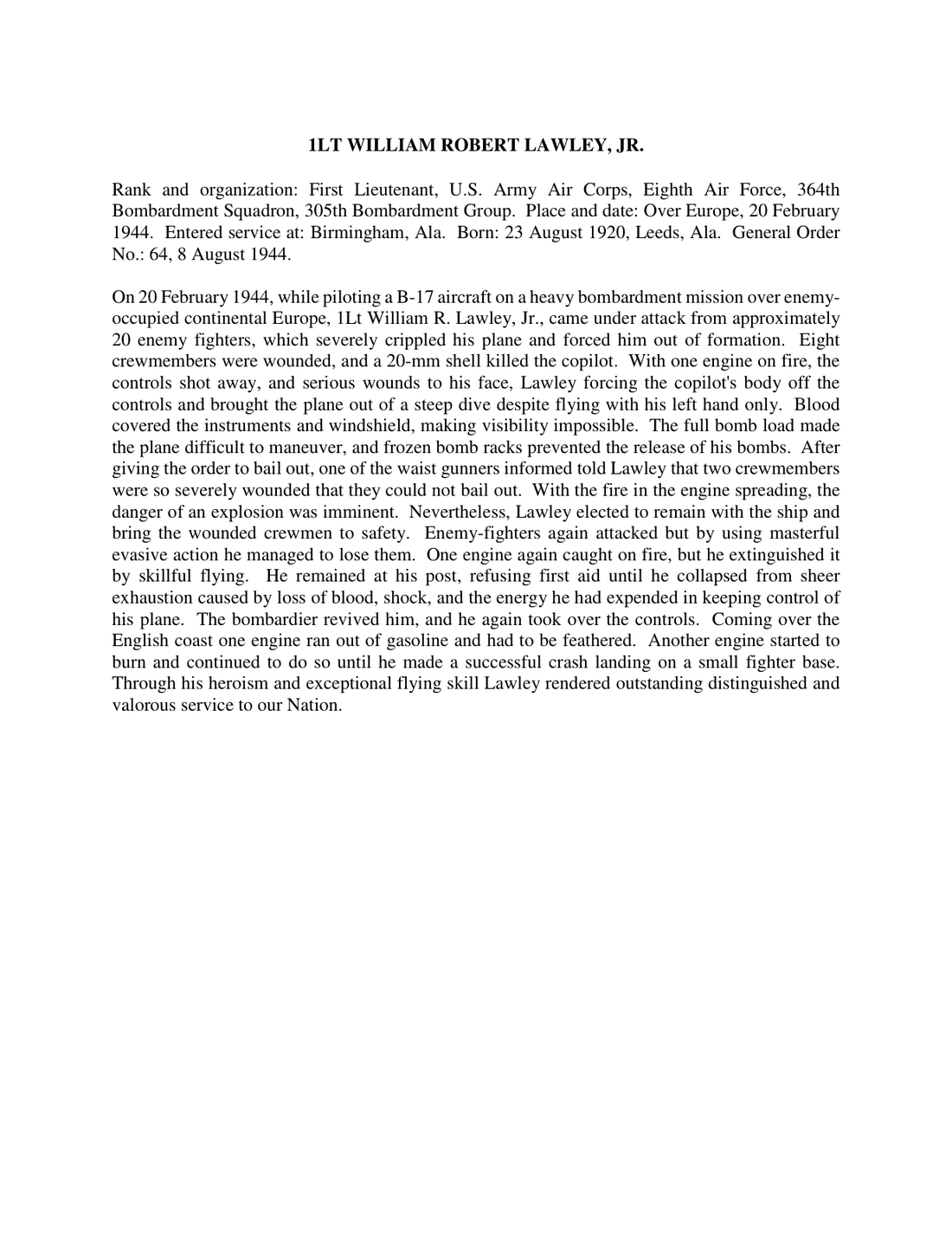
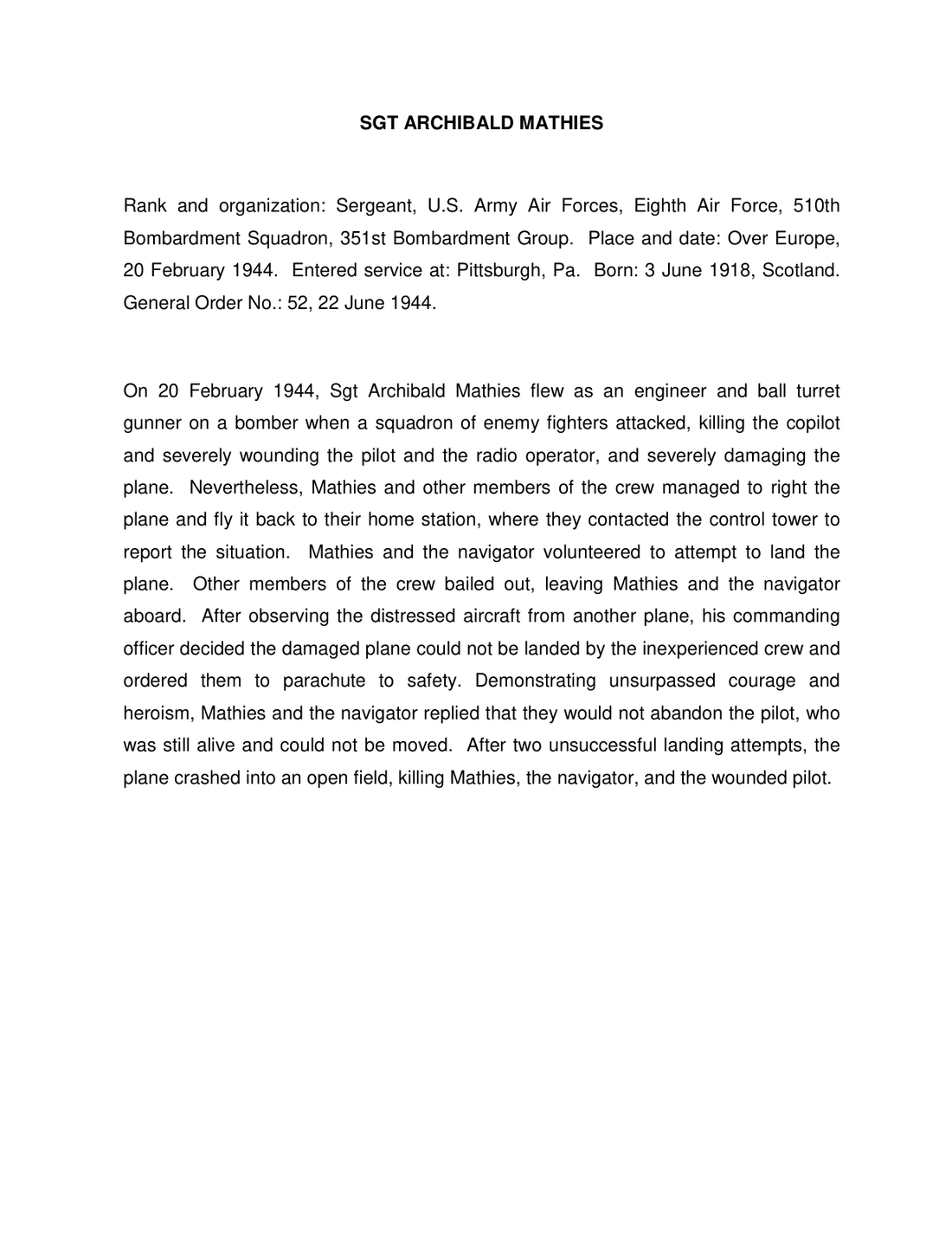
Bomber Airman Heritage: Three air warriors from Eighth Air Force became recipients of the Medal of Honor for their heroism during Big Week. The recipients included First Lieutenant William R. Lawley (B-17 pilot), Second Lieutenant Walter E. Truemper (B-17 navigator), and Sergeant Archibald Mathies (B-17 flight engineer and ball gunner). The Medal of Honor citation for Lieutenant Lawley and Sergeant Mathias are attached. (The citation for both Lieutenant Truemper and Sergeant Mathias parallel each other except for the personal data since both were on the same bomber aircraft.)
Lane
"History tells you where you are going and why."
"History makes you smart. Heritage makes you proud."
Historian, Eighth Air Force
Historian, Joint-Global Strike Operations Center
Historian, Air Forces Strategic-Air Directorates
Historian, 95th Wing
©2026 W. Lane Callaway