

Date of Dispatch 29 January 2026 |
Reference No. 8 AF/HO 26-0129 |
Historical Event Date 29 January 1944 | |
Subject Employing Technology -- Pathfinder Radar | |
To Neuman, Ty W Maj Gen USAF AFGSC AFGSC/8th AF | |
From Callaway, William L CIV USAF AFGSC 8 AF/HO | |
General, A milestone in Eighth Air Force generating strategic airpower and leveraging new technology thus contributing to a cascading effect.
29 January 1944, Largest Eighth Air Force mission to date in World War II: 8 AF Mission #198 dispatched 864 bombers - a mixed force of B-17s and B-24s - with VIII FO #226 dispatching 632 fighters to strike industrial targets in Frankfurt am Main - known as the "Chicago of Germany" due to the concentration of industrial facilities and manufacturing complexes in this urban area. For this specific mission - 1,896 tons of munitions and 2.6 million propaganda leaflets - were dropped on designated industrial sites using "blind bombing" airborne radar devices and techniques due to cloud cover over Frankfurt. The Eighth Air Force (8 AF) lost 29 bomber aircraft and 15 fighters during this specific mission. Gunners aboard bomber aircraft claimed 75 aerial victories downing German fighter aircraft with an additional 47 aerial victories by 8 AF fighter pilots.
Rest of the Story: Frankfurt being a primary and significant industrial center for Germany had been struck numerous times previously by 8 AF in daylight hours and by the Royal Air Force Bomber Command during night time hours. However, 8 AF Mission #198 was noteworthy in two items. This specific air mission was the largest dispatch of airpower by 8 AF to date and this mission also facilitated a change in the Eighth's operational pattern with modified air tactics using "Pathfinder" lead bombers equipped with airborne radar devices to negate the cloud cover.
New Technology Experimentation: Overcast skies over Europe or over a designated target had been a significant factor in re-calling bomber formations on their way to strike the designated target. In late 1942, the Eighth began to experiment with a variety of British-produced airborne radars installed in selected bomber aircraft. By April 1943, bomber formations had begun to use a "Pathfinder" bomber equipped with an airborne radar device as the lead bomber to find the designated target through cloud cover - hence the leveraging of new technology.
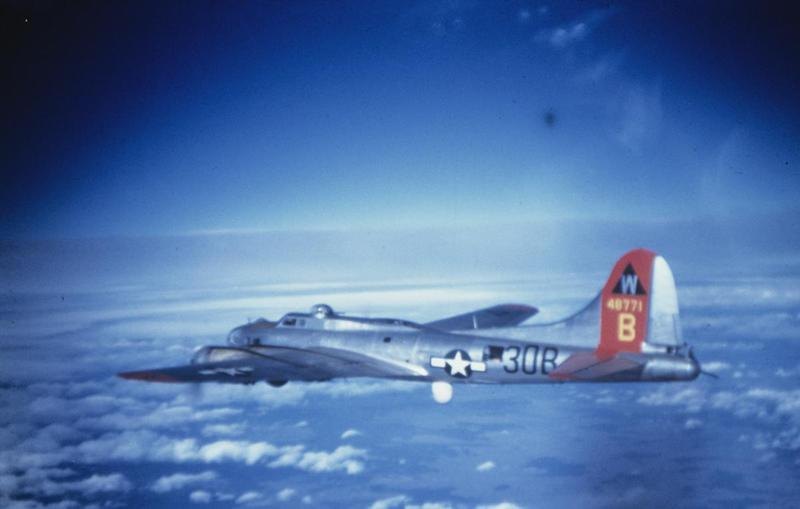
Air tactics used by bomber formations changed; when the airborne radar-equipped leading Pathfinder bomber dropped its bomb load this was a signal to the following bomber formation to release their bombs as well. As Pathfinder-led air tactics improved, the leading Pathfinder bomber started to drop colored flares to mark the designated target area. These flares created long trails of colored smoke to further mark the target for additional follow-on bomber echelons.
Overtime as airborne radar devices become more available and with a corresponding increase in the number of Pathfinder radar-equipped lead aircraft, Eighth Air Force ramped up its operational tempo thus leading to this largest 8 AF air mission to date on 29 January 1944. Attached is a unique color photograph showing an example of a Pathfinder B-17 assigned to the Eighth's 398th Bomb Group with the extended airborne radar device clearly seen.
Assisted by the use of Pathfinder aircraft equipped with airborne radars, the operational tempo of Eighth Air Force greatly increased thus implementing the aggressive guidance by General Hap Arnold, the Commanding General of the United States Air Forces to seek out and destroy the German Air Force - whether in the air, on the ground, or airplanes being built in German factories. The winter of 1943 into 1944 in Europe was noted as having more cloudy overcast days than normal, so the airborne radar-equipped Pathfinder aircraft leading follow-on bomber formations enabled Eighth Air Force to increase its operational tempo.
Cascading Effect: The goal of destroying the German Air Force directed by General Arnold was a significant part of a larger vision of achieving air superiority over Europe. This air superiority over the German Air Force was a must so to facilitate the then forthcoming planned return of Western Allied ground forces to the European Continent through the beaches of Normandy on D-Day implementing Operation Overlord. Use of airborne radar equipped Pathfinder aircraft to find designated targets through cloud cover greatly contributed to the cascading effect of achieving air superiority by the Western Allies over the Continent of Europe.
Lane
"History tells you where you are going and why."
"History makes you smart. Heritage makes you proud."
Historian, Eighth Air Force
Historian, Joint-Global Strike Operations Center
Historian, Air Forces Strategic-Air Directorates
Historian, 95th Wing
©2026 W. Lane Callaway